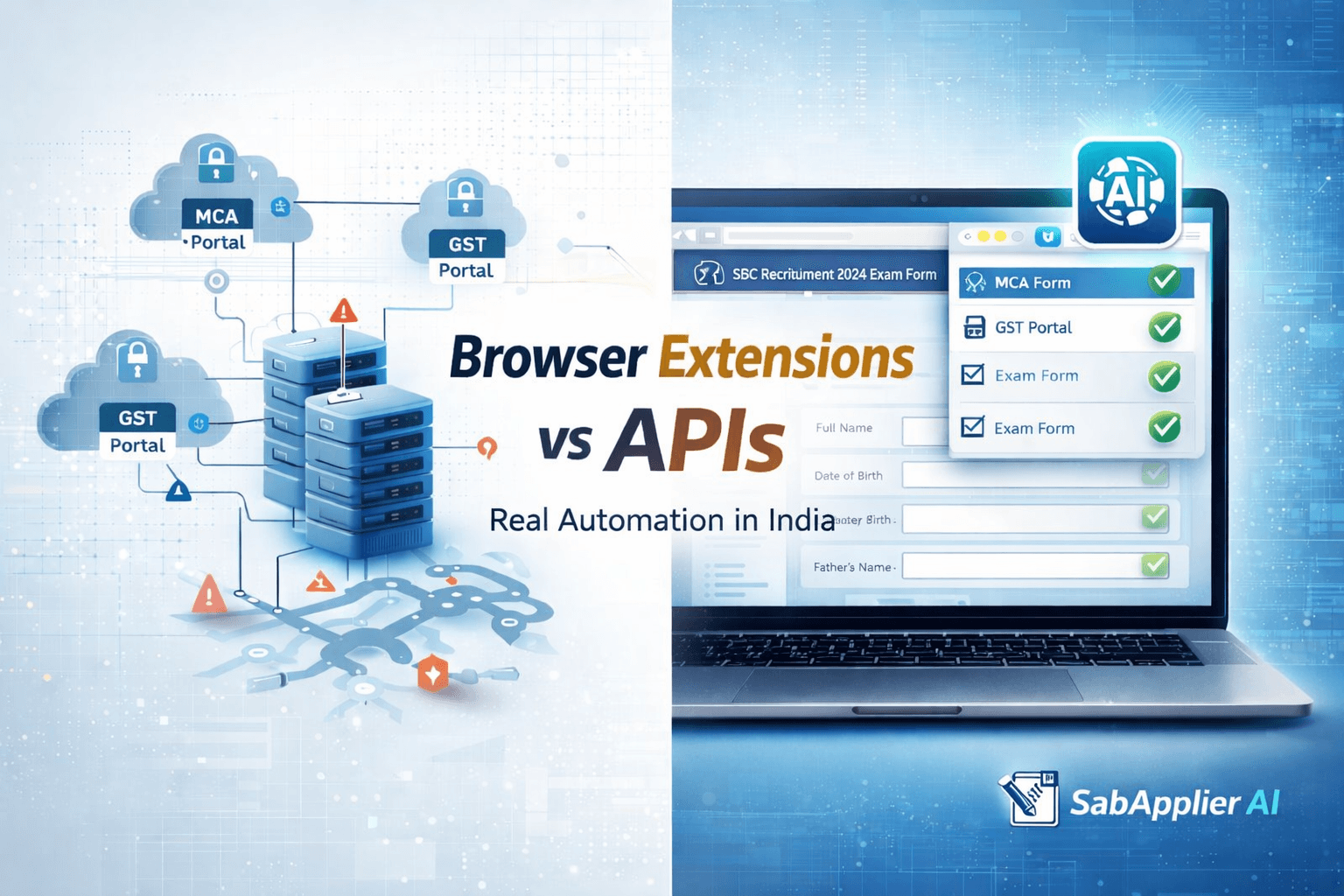
Browser Extensions vs. APIs: How Real-World Automation Actually Works
SabApplier AI Team
Product & Research
In the ivory towers of software engineering, we are taught that APIs (Application Programming Interfaces) are the ultimate solution for connectivity. "Build an API-first architecture," they say. But if you have ever tried to automate a filing on the MCA V3 portal or upload an invoice to the GSTN, you know that the "API-first" dream often hits a concrete wall.
The reality of the Indian digital economy in 2026 is messy. It is defined by session timeouts, unannounced layout shifts, and the high-stakes pressure of "DSC not found" errors.
"Ek hi details kitni baar fill karun?" (How many times do I fill the same details?). This frustration exists because the "Happy Path" of APIs rarely exists for the common user. While the world chases clean code, the real world is won by those who can navigate the "Walled Gardens" of government infrastructure.
At SabApplier AI, we've realized that to win in India, you don't just need automation; you need Resilient Agentic Automation.
1. The Automation Paradox: Why the "Happy Path" Fails
In technical terms, the "Happy Path" is a scenario where everything works perfectly—the API is up, the token is valid, and the data schema matches. But the Indian G2B (Government-to-Business) landscape is built on Edge Cases.
Why APIs Hit a Wall:
- ✓Walled Gardens: Portals like UPSC, SSC, and MCA often do not offer public "Write" APIs. They allow you to "Read" data, but "Submission" is restricted to the web interface to ensure manual verification.
- ✓The Paywall Problem: Even where APIs exist (like GSTN), access is often gated behind expensive GSP (GST Suvidha Provider) licenses costing upwards of ₹5 Lakhs. This creates a massive barrier for SMBs and independent CAs.
- ✓The Hardware Air-Gap: Cloud-based APIs cannot physically talk to the USB DSC Token plugged into your laptop.
This is why Browser Extensions are not just a "hack"—they are a strategic necessity. They operate at the presentation layer (the DOM), allowing them to "see" exactly what you see.
2. The Technical Renaissance: Manifest V3 & Resilient DOM
The technology powering browser automation is undergoing a radical shift with Google's Manifest V3 (MV3).
The End of Persistent Background Scripts
Under the old MV2, extensions stayed "awake" forever. In MV3, we use Service Workers—which are ephemeral and event-driven.
- ✓The Challenge: If a service worker "dies" while waiting for the GST portal to generate a heavy report, the automation fails.
- ✓The SabApplier Fix: We utilize Offscreen Documents for long-running processes, ensuring the automation persists even when the portal is lagging.
3. The React "Ghost Input" Problem
Modern Indian portals are built using React or Angular. Traditional "dumb" Autofill tools often set a field's value but fail to trigger the site's internal "State."
- ✓The Symptom: You see your name in the box, but when you click "Submit," the portal says "Field is mandatory."
- ✓The Agentic Solution: SabApplier AI uses Synthetic Event Dispatching. We tell the React application, "Hey, a human just entered this data," ensuring the portal's internal brain registers the input. This eliminates the "Ghost Input" errors that plague basic tools.
4. The Hardware Gatekeeper: DSC & Native Messaging
The Digital Signature Certificate (DSC) is the ultimate reason why cloud-only APIs fail. Statutory filings in India require a private key stored inside a FIPS-compliant USB token.
The Technical Workflow:
- ✓The MCA/GST Portal generates a "Hash" of your document.
- ✓The SabApplier Extension receives this hash.
- ✓Through the Native Messaging API, the extension talks to a local "Host App" on your PC.
- ✓The Host App communicates with your USB Token to sign the hash.
Without a browser-based bridge, this entire secure chain breaks.
5. The 70/30 Hybrid Rule: How SabApplier AI Wins
Real-world automation follows a 70/30 Hybrid Model:
- ✓70% API: Used for background data validation and fetching internal records.
- ✓30% Browser Agent: Reserved for the "Last Mile"—the final portal interaction where visual verification and hardware signatures are required.
Why Browser-Based AI Agents are the Future:
Unlike brittle scripts that break if a `<div>` changes to a `<span>`, SabApplier uses Vision-Language Models (VLM). We identify the "Submit" button because it *looks* like a submit button, not just because of its code. This makes our automation "Self-Healing."
6. Security & The DPDP Act 2023
In 2026, data localization is law.
- ✓The API Risk: Using a foreign API service means sending your sensitive Aadhaar/PAN data to a cloud server outside your control.
- ✓The Client-Side Advantage: SabApplier AI processes your documents Locally in your browser. The data only leaves your machine when it is sent directly to the government portal. This minimizes your risk as a "Data Fiduciary" under the DPDP Act.
🏁 Conclusion: The Future is Hybrid
The debate between Browser Extensions and APIs is over. In the friction-heavy Indian digital economy, the winner is the Hybrid Agent.
Whether you are a student filling a NEET form, a founder registering a startup on MCA V3, or a CA managing GST filings, you need a tool that can handle the chaos of the DOM and the rigidity of the law.
SabApplier AI is built for the real world. Not just for the "Happy Path," but for the "Indian Path"—where accuracy, persistence, and local security are non-negotiable.
Stop Waiting for APIs. Start Automating Today.
🚀[Join the Resilient Automation Movement with SabApplier AI]
🌐Visit: www.sabapplier.com
#BrowserAutomation #APIsVsExtensions #ManifestV3 #DigitalSignature #MCV3 #GSTN #DigitalIndia2026 #SabApplierAI #DPDPAct #AutomationArchitecture
Never Miss an Update
Join 10,000+ students and professionals using SabApplier AI.